


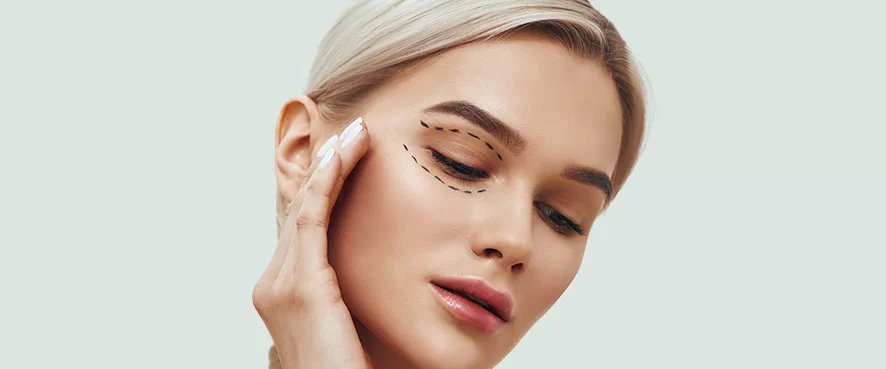
Aesthetic procedures and interventions performed to remove excess muscle tissue formed due to skin sagging around the eyes fall under the category of eyelid aesthetics. As a result of aging, skin sagging is expected to occur in various parts of the human body. The main idea behind aesthetic corrections in the periocular area is to tighten the sagging skin in this region, which in turn gives the gaze a much more youthful appearance.
Various problems can arise in the periocular contour, such as the formation of fat pockets, loosening, expansion of the skin and musculature, and changes in skin color in this area. Correcting these problems with the help of surgical procedures answers the question: What is Blepharoplasty?
Blepharoplasty can be performed on the upper and/or lower eyelid and differs in terms of methodology depending on the specific area.
Upper Eyelid Blepharoplasty can be defined as a surgical procedure to remove excess sagging skin from the upper eyelids. The excess skin and muscle tissue in this area is removed through surgical excision. The incision is made along the crease line of the eyelid, aiming to minimize the visibility of scars after the surgical procedure.
When performing classic Lower Eyelid Blepharoplasty, the incision is made just below the lower eyelid lash line. Then the skin is lifted and the formed fat pockets are evenly distributed in the under-eye hollow. Finally, after the excess skin and muscles are excised, surgical suturing is performed to complete the procedure. In some cases, when the patient's own fat tissue in the under-eye area is insufficient and there is hollowing in this area, additional injection of the patient's own fat tissue taken from another area of their body may be necessary.
Another method used in lower eyelid blepharoplasty is the transconjunctival method, also known as the "scarless" method. This method is applied to patients who do not have significant skin sagging in the under-eye area but have formed fat pockets under the eyes. With this method, the fat packets (pockets) can be removed through surgical access from the inner side of the eyelid, without creating a scar on the skin.
To determine which method is most suitable and effective for the patient, a detailed physical examination by a specialist is necessary as a first step.
What should be considered before and after eyelid aesthetics?
The use of antibiotics and blood-thinning medications such as aspirin should be discontinued at least 15 days before the planned procedure to prevent increased tendency for bleeding during the surgery. Additionally, smoking should be avoided for a period of at least two weeks before and after eyelid aesthetics, as it delays wound healing. To avoid any unexpected results from the procedure, medications or creams not prescribed by the treating physician should not be used.
If patients pay attention to a few small details, a smooth postoperative period can easily be achieved.
For 2 days after the procedure, activities that will strain the eyes should be avoided. Additionally, the drops and medications prescribed by the treating physician should be used strictly. For 2 weeks after the procedure, applying makeup to the surgical area should be avoided due to the risk of infection. It is recommended to wear sunglasses during the recovery period to protect the eyes from the harmful effects of direct sunlight.
Upper or lower eyelid aesthetics is not a painful surgical procedure. After the surgery, tearing, dryness, or a burning sensation in the eyes may occur. The ideal time for suture removal may vary depending on the specific case. Usually, the patient can return to work within 1 week after the surgery, but it may be necessary to wait 2-3 weeks for vision to fully recover and the swelling to subside.
Eyelid aesthetic procedure prices vary depending on the patient's condition, the proposed procedure, the method by which it will be performed, and other parameters. To obtain clear and accurate information on this matter, a detailed physical examination by a specialist must first be performed, and then you will be able to receive detailed information from the respective physician about your current condition and the most effective treatment for your case.

 Viber
Viber
 Whatsapp
 Phone
Phone